

You worked hard to get here. Four years of school, maybe a few internships, and now your first real job. You are up early, you are on someone else’s schedule all day, and you are taking direction from people who don’t always say thank you. So when you stop for a latte on the way into the office, or order dinner on DoorDash because you are simply too tired to cook, it doesn’t feel like a splurge. It feels earned.
And honestly? You do deserve to enjoy your life. That is not the argument here. The argument is that how we define “deserve” in our twenties quietly shapes what our lives will look like in our forties, fifties and sixties. Today’s lifestyle is one of the biggest reasons so many smart, hardworking young people never really get ahead.
It’s Never Just One Thing
Nobody goes broke on a single latte. That is why the “skip the coffee” advice gets an eye roll. The problem is that it is never just the latte.
The latte goes with the DoorDash. The DoorDash goes with the Erewhon smoothie. The smoothie goes with the boutique workout class at $35 a session. Then there is Sunday brunch with friends, the matcha you grab in the afternoon, and the “just this once” delivery order on a Wednesday because the week has been long.
None of it feels extravagant. It is all fun, and most of it is social. That is exactly what makes it so hard to see, and so hard to stop. Each purchase is small enough to ignore, and together they become a habit and then a lifestyle.
Let’s Look at the Real Numbers
Picture a 22-year-old, fresh out of college, in a first job paying somewhere between $50,000 and $75,000. Before a single latte is purchased, taxes come off the top. Then comes rent, which in most cities today will easily eat up around 40% of that salary. What is left has to cover a car or transit, insurance, phone, groceries, student loans and everything else.
Now add the extras. In a single week it is easy to spend at least $100 without trying:
- A few workout classes
- Weekend brunch
- Two or three delivery meals
- A stop at Erewhon
- A daily latte or matcha
That is roughly $400 a month. On a $50,000 to $75,000 salary, that is a meaningful slice of whatever is left after taxes and rent, and it rarely feels like a choice. It just feels like Tuesday.
Bring Out the Compound Interest Calculator
To really understand the impact, you have to look past the monthly number and ask a different question: what would that money become if it went to work for you instead?
Say that same 22-year-old makes a few swaps. Coffee gets made at home. The $35 class becomes a walk, a run or a free workout on YouTube. On Sunday, a stop at Trader Joe’s and an hour of meal prep replace most of the week’s delivery orders. The $400 a month that used to disappear goes into a low-cost index fund instead.
Assuming an average annual return of 9%, here is what that $400 a month grows into:
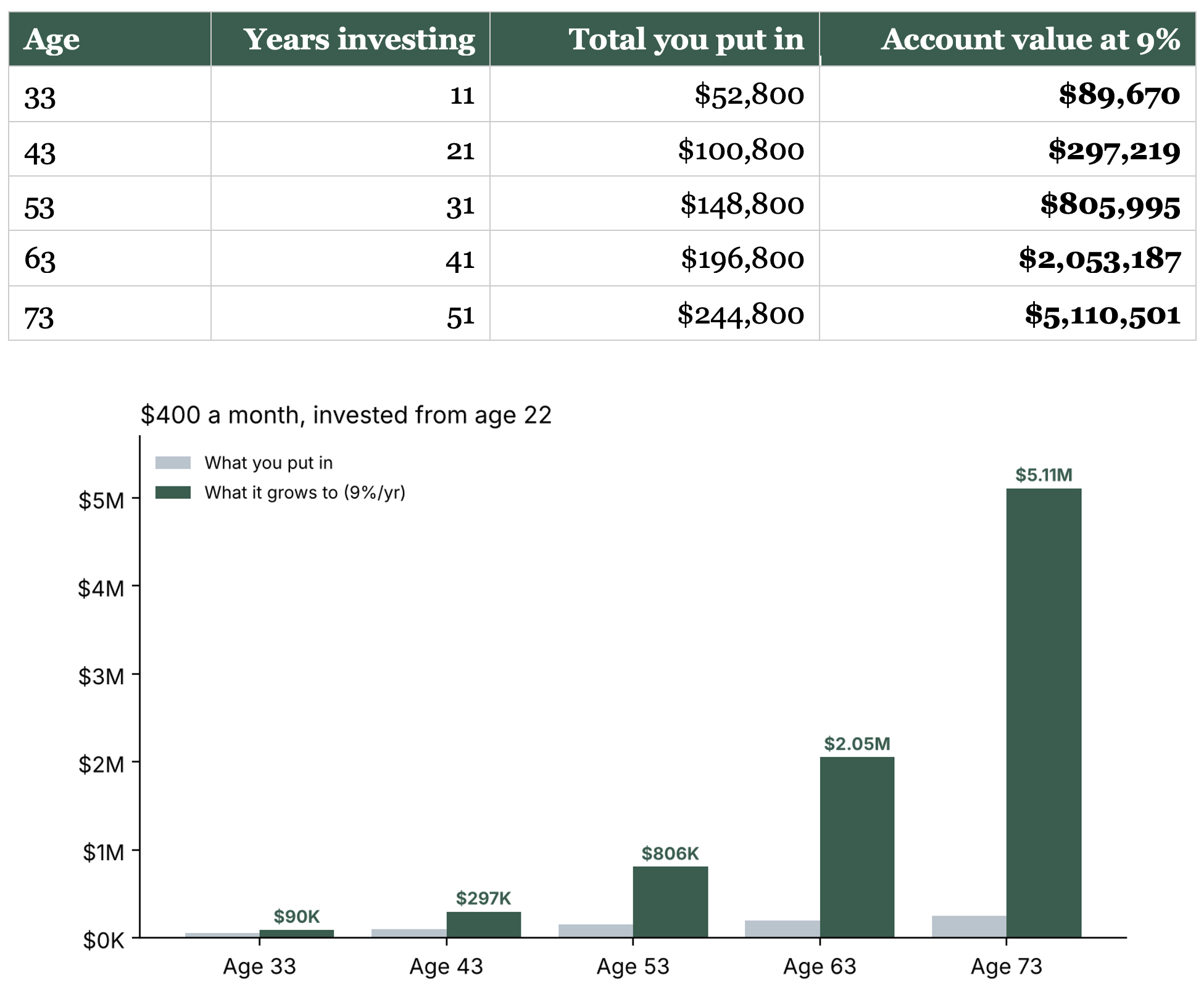
Look closely at the gap between what goes in and what comes out. By 63, about $197,000 of contributions has grown to more than $2 million. More than 90% of that money is growth that you never had to earn by working. That is compound interest doing what it does best, and it is why starting at 22 matters so much more than starting at 32. The early dollars have the longest time to multiply.
A note on the math: These figures assume $400 invested every month starting at age 22, with a steady 9% average annual return compounded monthly. Real markets don’t move in a straight line, and some years will be negative. Returns are not guaranteed, and a dollar in 40 years will buy less than a dollar today because of inflation. The direction of the story, though, holds up: small, consistent investing over a long time builds real wealth.
From “I Can’t Afford It” to “My Money Is Working for Me”
Most people approach cutting back as deprivation. “I can’t afford it” feels like a punishment, and punishments don’t last. Within a few weeks the delivery apps are back and the class pack is renewed.
The shift that actually sticks is a change in what gives you satisfaction. Instead of the quick hit of an $8 latte, there is a quieter and more lasting feeling: knowing your money is making money for you, every single day, while you sleep.
It’s not “I can’t afford it.” It’s “I get more satisfaction from having my money make money for me.”
Here is a goal worth naming. By age 60, that same $400 a month would be worth roughly $1.56 million. Using a common rule of thumb that a portfolio can support withdrawals of about 4% a year, that is around $62,000 a year in income, close to the starting salary that made the latte feel so necessary in the first place. In other words, the habits you build at 22 can replace your paycheck by 60.
This Isn’t About Never Having Fun
None of this means you should never meet a friend for brunch or treat yourself to a great coffee. Life is meant to be enjoyed, and the social side of these moments matters. The point is to make them choices instead of defaults.
- Pick the one or two things you truly love and keep them. Let the rest go.
- Automate the investment so the money moves before you can spend it. Set up an automatic transfer to an index fund the day after payday.
- Make the free version a habit. Home coffee, outdoor workouts and Sunday meal prep become easy within a few weeks.
- Track it for one month. Most people are shocked at what the “little things” actually add up to.
You absolutely deserve good things. The question is whether you want them to be small things now, or a life of real freedom later. The good news is that at 22 you can have a little of both, as long as you decide on purpose.